
SPORTS MASSAGE · ATHLETIC RECOVERY · BANG TAO, PHUKET
SPORTS MASSAGE BANG TAO, PHUKET — RECOVERY AFTER TRAINING
Post-workout recovery massage for runners, triathletes, surfers and anyone training in Phuket. Flushing strokes, compression and targeted work on the muscles you loaded. With Woravalan Khollum — DHSS-registered, certified sports massage therapist, 25 years of practice. Private suite Bang Tao.
Best booked 4–24 hours after training. Available in-studio and at your villa or hotel.
Post-workout recovery · flushing strokes
Certified sports massage · therapist
Runners · triathletes · surfers
Private suite · Bang Tao · 500m from Boat Avenue
What sports massage is — and how it differs from other massage
Sports massage is a recovery tool. It is applied after training or competition to accelerate the physiological processes that return the body to its pre-exercise state — and to a state better than that, over repeated sessions.

The technique is different from relaxation massage and from therapeutic work for chronic pain. Sports massage uses moderate pressure in a specific sequence: flushing strokes (long effleurage from the extremities toward the heart, supporting venous and lymphatic return), compression on the belly of the loaded muscles, and targeted petrissage where the tissue needs it. The session follows the muscles you trained — a runner's session focuses on the quads, hamstrings, IT band, calves and hip flexors. A swimmer's session on the shoulders, lats and neck. An upper-body session on the chest, anterior deltoid and biceps.
The pressure is moderate. Sports massage is not meant to hurt. If the pressure is causing you to brace or hold your breath, it is too much — tell your therapist.
What separates a sports massage therapist from a general massage therapist is the understanding of athletic loading patterns, the sequencing of recovery work, and the timing relative to training and competition.
At Woravalan, sports massage is performed by Woravalan Khollum — DHSS-registered, certified sports massage therapist with 25 years of practice.
What sports massage does for recovery — the physiology
The case for sports massage is well-supported. The mechanisms are specific and measurable.
Lactate and metabolic waste clearance
Intense training produces metabolic byproducts — including lactate, hydrogen ions and carbon dioxide — that accumulate in muscle tissue and contribute to the burning sensation and fatigue during effort. After training, these byproducts must be cleared by the circulatory system. Sports massage accelerates this clearance through two mechanisms: the mechanical pressure of the strokes supports venous return from the extremities, and the increased local blood flow delivers fresh oxygen to the tissue simultaneously.
Reduction of DOMS
Delayed onset muscle soreness — the ache that peaks 24 to 48 hours after training — results from the inflammatory response to micro-damage in muscle fibre. Sports massage reduces the intensity and duration of DOMS by modulating the inflammatory response and by preventing the muscle from setting in a shortened, guarded state. Clients who receive sports massage within 24 hours of training consistently report less DOMS than those who do not.
Parasympathetic activation
Hard training keeps the nervous system in a sympathetic state — the system activates cortisol, increases heart rate and maintains muscle tone. Recovery requires the opposite: parasympathetic dominance, reduced cortisol and muscle tone at rest. Sports massage — with its rhythmic, moderate pressure — is one of the most effective triggers of the parasympathetic shift available outside of sleep.
Tissue maintenance
Repeated training in the same movement pattern creates predictable patterns of tightness in the muscles that work hardest and weakness in the muscles that are under-recruited. Regular sports massage identifies these patterns before they become injuries — when the IT band begins to restrict, when the hip flexors shorten, when the posterior shoulder capsule tightens in a swimmer. Addressing them early prevents the compensatory patterns that lead to injury.
Who books sports massage Phuket — and what we focus on
The training load in Phuket is high. The heat, the hills and the combination of activities that most people do here place specific demands on different muscle groups. Your therapist adapts the session to what you actually trained.
Running and triathlon
Quads, hamstrings, IT band, calves, hip flexors, psoas. The Phuket hills add significant eccentric load to the quads and posterior chain that flat-surface runners may not be accustomed to.
Surfing and watersports
Rotator cuff, lats, triceps, posterior neck, hip rotators. The paddling pattern creates anterior shoulder dominance over time. Sports massage on the posterior chain of the shoulder balances this.
Crossfit and gym training
Posterior chain after squats and deadlifts. Pectorals and anterior deltoid after pressing sessions. Thoracic mobility after heavy loading. Forearm flexors after grip-intensive work.
Cycling
Quads, IT band, hip flexors and glutes — the same pattern as running with more emphasis on the hip flexors due to the fixed position of the foot. Lower back and posterior neck from the cycling position.
Multi-sport and general training
Mixed load, adapted to the session you describe. Tell your therapist what you trained in the last 48 hours and she will sequence accordingly.
RACE RECOVERY
Laguna Triathlon, Phuket Marathon and local events in Phuket. Book the morning after — not the evening before.
When to book — timing relative to training and events
If you are racing in Phuket — the Laguna Phuket Triathlon, the Phuket Marathon or any local event — book your recovery session for the morning after, not the evening before. Woravalan knows this protocol and will ask about your event when you book.
BEST TIMES:
- 4–24 hours after training: optimal window for recovery massage. The acute inflammatory phase is past; the tissue is ready for work.
- The morning after a long run, hard ride or heavy session: before DOMS peaks.
- Weekly during a training block: maintenance that prevents accumulation.
AVOID:
- Immediately before competition: sports massage increases local circulation and temporarily reduces power output. Do not book within 12 hours of a race or event.
- Immediately after an acute injury: wait for medical assessment first.
- During illness or fever: for obvious reasons.
What happens during a sports massage session at Woravalan
You arrive and tell Woravalan what you trained and when. She asks about any areas of concern — tightness, a specific muscle that is talking to you, anything that did not feel right during training. Two minutes.
You lie on the table. The session begins with broad effleurage strokes on the primary muscle groups you loaded — long, rhythmic strokes from the distal end (the foot, the hand) upward toward the heart. This is the flushing phase: it supports venous return and begins the clearance of metabolic waste. You will feel this as a satisfying release almost immediately.
After the flushing phase, she moves to compression on the muscle belly — not to go deep, but to increase local circulation and soften the tissue. She uses her palms and the heel of the hand rather than the thumbs: broader contact, less point pressure.
If she finds a specific area of tightness — a section of the IT band that is gripping, a knot in the upper calf from hill running — she will work it more specifically, but still with moderate pressure. The goal is recovery, not treatment of a chronic problem.
The session ends with passive stretching of the worked muscles — held gently, not forced. Most clients feel noticeably lighter before they leave the table.
A 60-minute session covers two to three major muscle groups thoroughly. A 90-minute session covers the primary and secondary groups and includes the passive stretch work.
After the session: drink water, eat within two hours, avoid hard training for 24 hours.
Your therapists — both women, both licensed
Two therapists, 35+ years of practice between them. Both are registered with the Department of Health Service Support. You can request either by name when you book, or leave it to us.
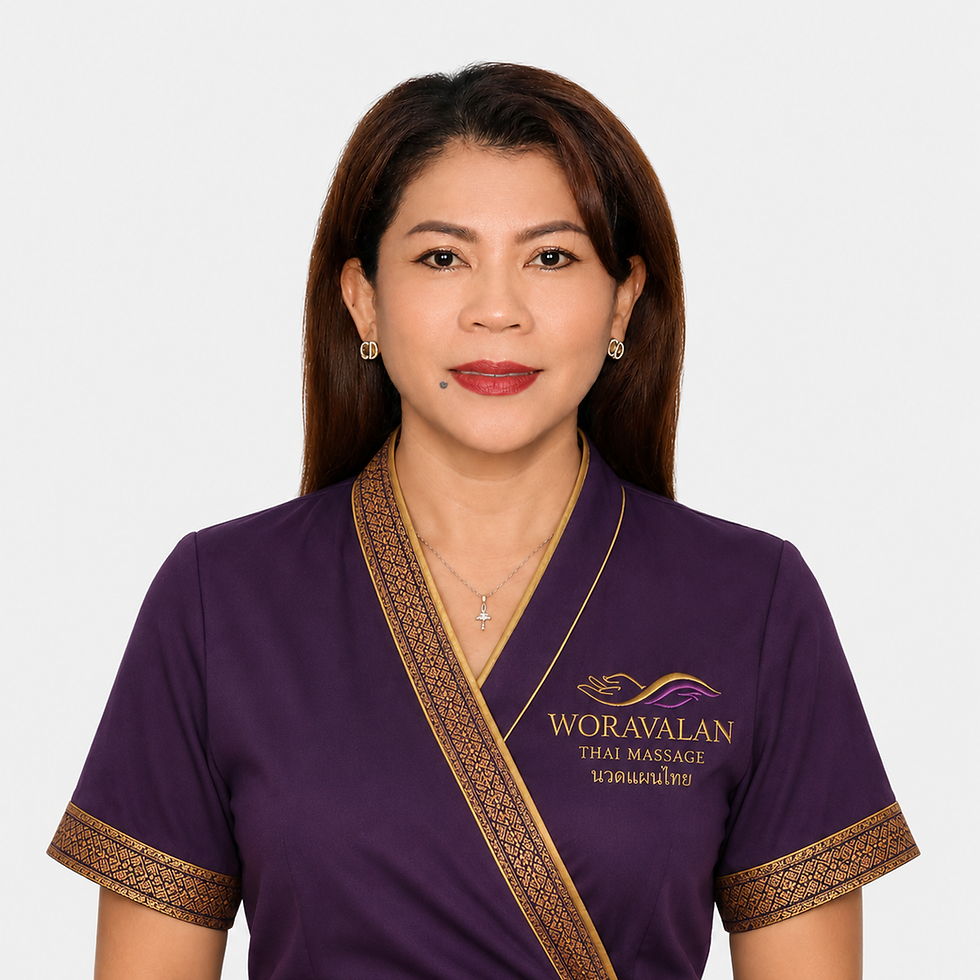
Head therapist · 25 years
Trained by the Thai Traditional Massage Society, 500+ hours. Previously at Amanpuri on Pansea Beach and InterContinental Samui. Traditional Thai, sports and deep tissue, lymphatic drainage, prenatal massage. Speaks Thai, English and understand Russian. The studio carries her name.
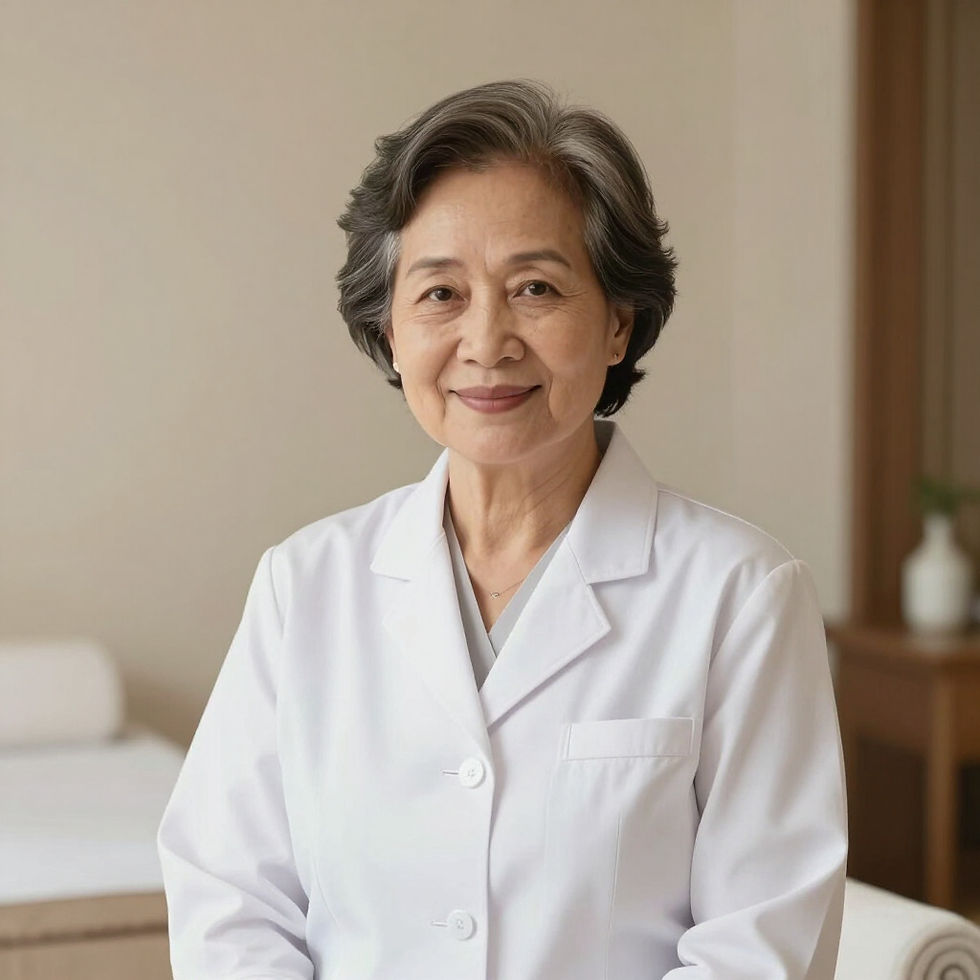
Senior therapist · 10+ years
Traditional Thai, sports and deep tissue, relax, head, neck and shoulders, oil and aroma, foot reflexology. Certified by the Thai Traditional Massage Society.
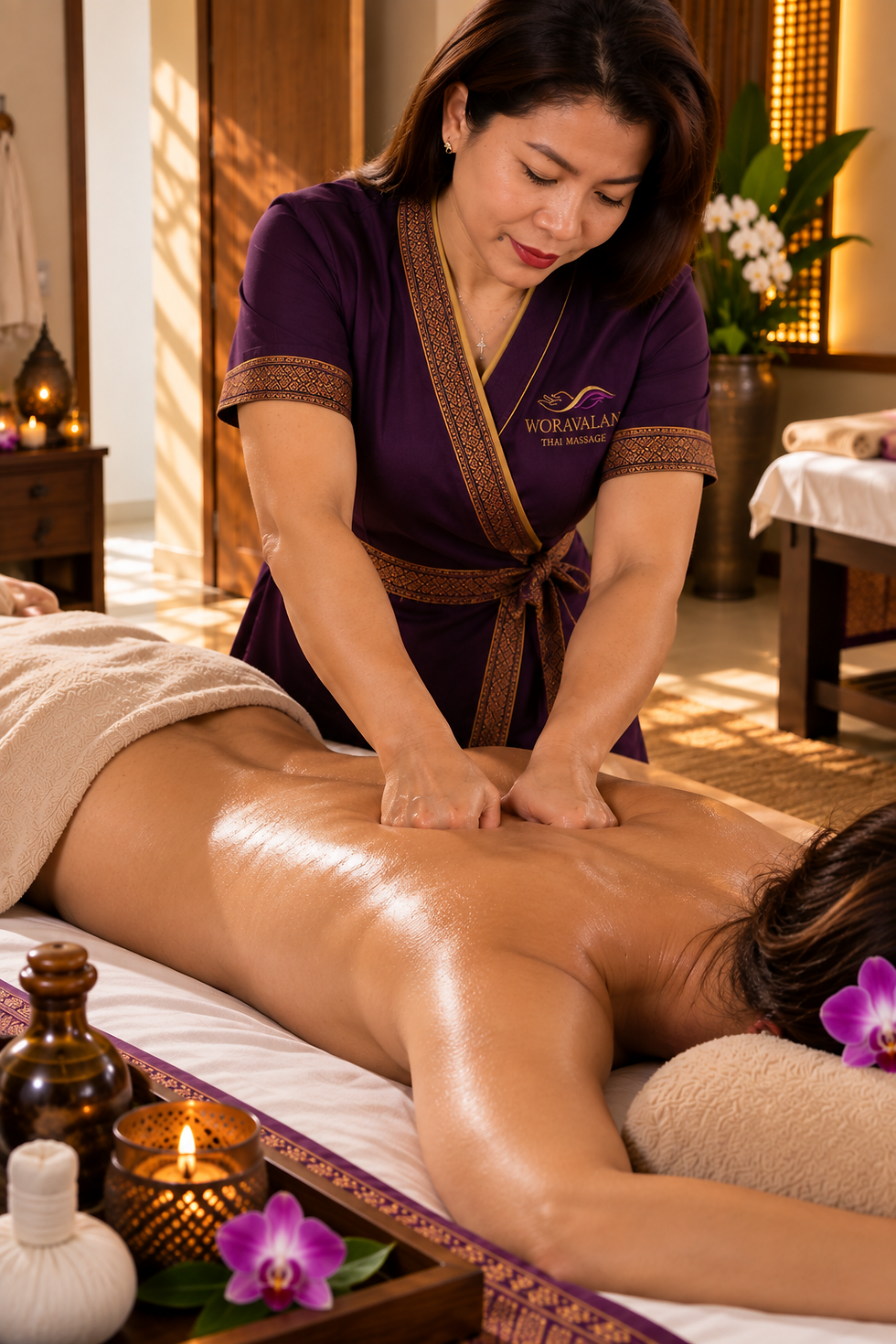
What’s included
Oil
Thai technique
Cotton costume
Loose trousers and top provided
Welcome drink
Herbal tea or chilled water on arrival
Personal shower room
Private, available before or after
Private suite
One booking per room, door closed
Licensed therapist
DHSS-registered, 25 years practice
Private suite
one booking per room

DHSS-licensed
both therapists

Free pickup
Bang Tao · Laguna · Layan
Villa sessions
available on request
OUTCALL MASSAGE SERVICE
OUTCALL MASSAGE SERVICE BANG TAO, PHUKET — YOUR THERAPIST COMES TO YOU
Your therapist travels to your villa, hotel room or private residence across Bang Tao, Layan, Surin and Laguna in Phuket. Traditional Thai, oil massage, deep tissue, hot stone and more — delivered as a full outcall service. We bring the table, linens, oils and music. You pick the spot. We arrive, set up in ten minutes and leave no trace.
DHSS-Registered Therapists
Full Spa Setup & Oil Provided
Available 9:00 AM - 19:00 PM
Bang Tao
Layan
Surin
Phuket
Laguna
Questions about sports massage before you book
HOW TO FIND US BANG TAO, PHUKET
We are the white two-storey building next to FOODBAR in Bang Tao, with the parking between us.
- Laguna Phuket — 5 min
- Bang Tao Beach — 5 min
- Layan Beach — 8 min
- Surin Beach — 10 min
- Phuket airport — 25 min
No traffic variation at any hour.
Woravalan Thai Massage
ADDRESS: 15 Soi Cherngtalay 14 Bang Tao Beach,
Choeng Thale, Thalang District, Phuket 83110
Open daily 10:00–22:00
Other treatments at Woravalan
After your session at the gyms in Bang Tao and Cherngtalay
We are the closest sports massage studio to the main training facilities in Bang Tao and Cherngtalay. Most clients walk or ride five minutes from the gym to the suite.
We offer free pickup from all four facilities after your training session. Tell us where you trained when you book and we will collect you at the time that fits your cool-down.
Bangtao Muay Thai & MMA
72/46 Moo 3 Cherngtalay · 5 min from our studio
Muay Thai, MMA, BJJ, wrestling
After Muay Thai, MMA, BJJ and wrestling training the primary areas that need recovery work are: the hip flexors and quads from kicking, the posterior shoulder and rotator cuff from clinch and grappling, the neck and upper trapezius from maintaining guard position, and the forearms and hands from grip-intensive grappling sessions.
A 90-minute post-training session covers the full striking and grappling load. Book 4–24 hours after training — not the same evening if you have a hard session scheduled the next morning.
Delta55 Fitness
Inside Boat Avenue · literally 500 metres from our studio
Strength, functional fitness, boxing
Delta55 members typically load the posterior chain (squats, deadlifts), the pressing muscles (chest, anterior deltoid, triceps), and the pulling muscles (lats, biceps, posterior deltoid) depending on the day. The boxing and functional fitness room adds a striking load to the mix.
A 60-minute session after a strength day focuses on the primary movers you loaded. A 90-minute session covers the full body pattern including the thoracic spine and hip flexors that get compressed in heavy compound lifting.
Gym Club Phuket
Laguna · one minute from Boat Avenue · 6 min from our studio
CrossFit, HIIT, mixed conditioning
Gym Club's CrossFit, HIIT and CrossFit-style programming creates a mixed load: hip hinge patterns, overhead pressing, pulling and high-intensity cardio. The ice bath on site handles acute inflammation — sports massage handles the structural recovery: the hip flexors after box jumps, the posterior shoulder after pull-ups and rope climbs, the calves and Achilles after jump-heavy sessions.
Note: Gym Club has its own sauna and ice bath. We recommend using those first immediately after training, then coming to us 4–6 hours later for the massage recovery session. Cold exposure then massage: the optimal sequence.
Sculpt Reformer Pilates
Soi Bang Thao 2, Choeng Thale · 5 min from our studio
Reformer Pilates, eccentric control, hip stability
Reformer Pilates loads the body differently from strength and combat sports — the emphasis is on eccentric control, hip stability and thoracic extension. The areas that accumulate fatigue over regular Pilates sessions are the hip flexors (especially psoas in footwork and long box work), the glutes and hamstrings (footwork and jumping), and the posterior shoulder from straps and pulling patterns.
Sports massage after a Pilates-heavy week is lighter than after combat or CrossFit training — the nervous system load is lower and the muscle damage is minimal. The focus is on the hip flexor chain and the thoracic mobility that Pilates emphasises. A 60-minute session is usually right.